Seat two · halfway down, where the drawer pull sits
The Shallow Drawer: One Home for the Small Things That Wander
Most of our dining tables have a drawer so thin you could miss it. Customers ask why we bother. The answer is that the drawer is where a household keeps the things it is always looking for.
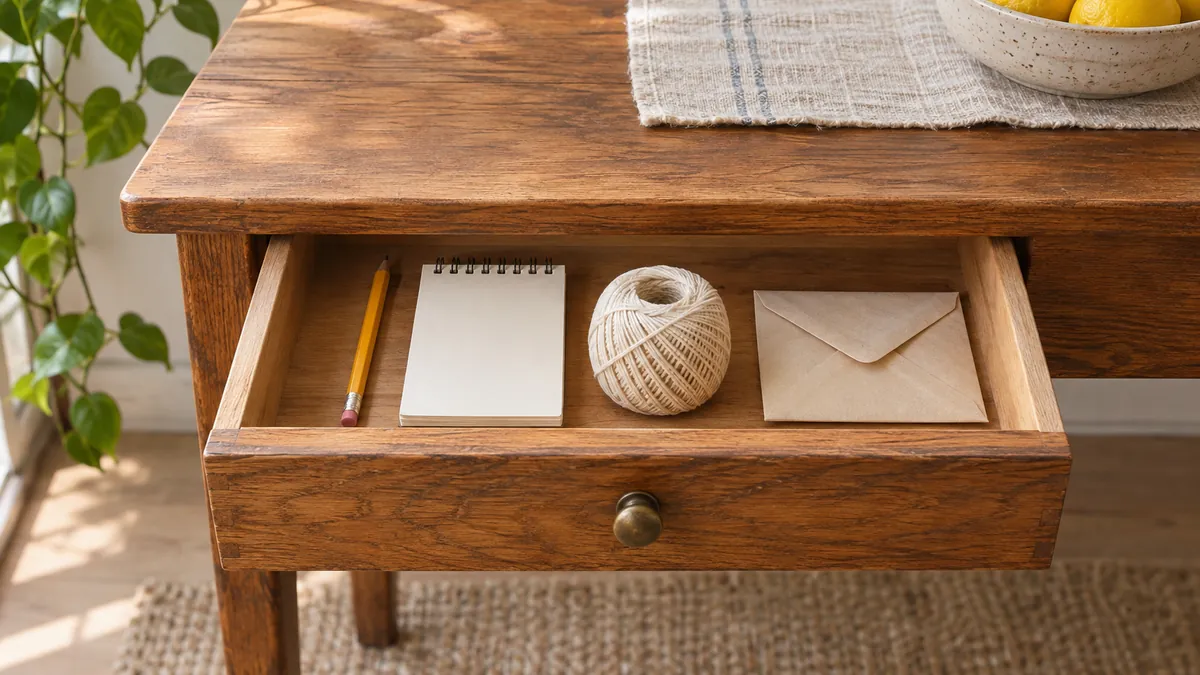
Why we still build it
The apron is the band of wood that runs under the edge of a tabletop and holds the legs square. On a long table there is room inside it for a drawer only a few fingers deep. It is too shallow for linens and too narrow for serving spoons, and for a while we considered dropping it from the catalogue. Then we asked the people who bought our tables what they kept there, and the answers came back almost identical: reading glasses, the spare key, a pen that works, the little box with the evening pills, a notepad. The small things that wander.
A drawer like that is a decision made once. You do not have to remember where the glasses are; you only have to remember that glasses live in the drawer. One rule replaces a dozen searches.
What the searching costs
Everyone loses keys. The trouble is less the lost key than the ten minutes of hunting that come with it, and the small spike of worry that turns up somewhere past fifty along with the question of whether misplacing things means something. Usually it means you set the key down while thinking about something else, which is exactly what attention does when it is split between two jobs. People who study memory in everyday life describe this kind of slip as a lapse in encoding: the brain never filed the moment, so there is nothing to retrieve. A fixed home works because it takes the filing out of the moment altogether.
The habit, as we would set it
Choose one place for each small thing that travels with you, and make the place as close as possible to where the thing gets used or dropped. A drawer by the door, a dish on the dresser, a hook beside the coat. Say the rule out loud the first week, which feels silly and helps. Glasses go in the drawer. Keys go on the hook.
Empty your pockets into the same spot every time you come home, before you take off your coat. It is the single most useful ten seconds in the day, because it happens at the moment your mind is still on the drive and not on the keys in your hand.
Keep a pad and a pencil in that same drawer, and when something needs remembering, write it before you do anything else. Not on your phone, which will open three other things on its way to the note. Paper and a pencil ask for nothing in return.
Once a month, take everything out of the drawer and put back only what belongs. A home that fills with odds and ends stops being a home and becomes another place to search.
A note from the bench
Our drawers run on plain wooden runners rubbed with wax, so they slide with one finger. A drawer that sticks is a drawer nobody opens, and then the glasses end up on the counter again. If your system has a step that annoys you, fix the annoying step before blaming yourself for skipping it.